Last night Julianne and I went out for dinner. While waiting for our food I was again messing around with my camera--and I got this look from Julianne . . . what a cutey!
The next day (today) I headed downtown to run some errands. It was nice outside although a bit cold.
I LOVE how delivery trucks in Korea pretty much operate however they see fit. I would absolutely be in photography heaven if this truck got in an accident (and nobody was hurt, of course) and the eggs went flying EVERYWHERE--lol.
Inside McDonalds waiting for our food I tried to do a 'cool' pic . . . TRIED . . . nope. I was hoping to get the image of the room reflected on the surface of the Christmas ball . . . argh.
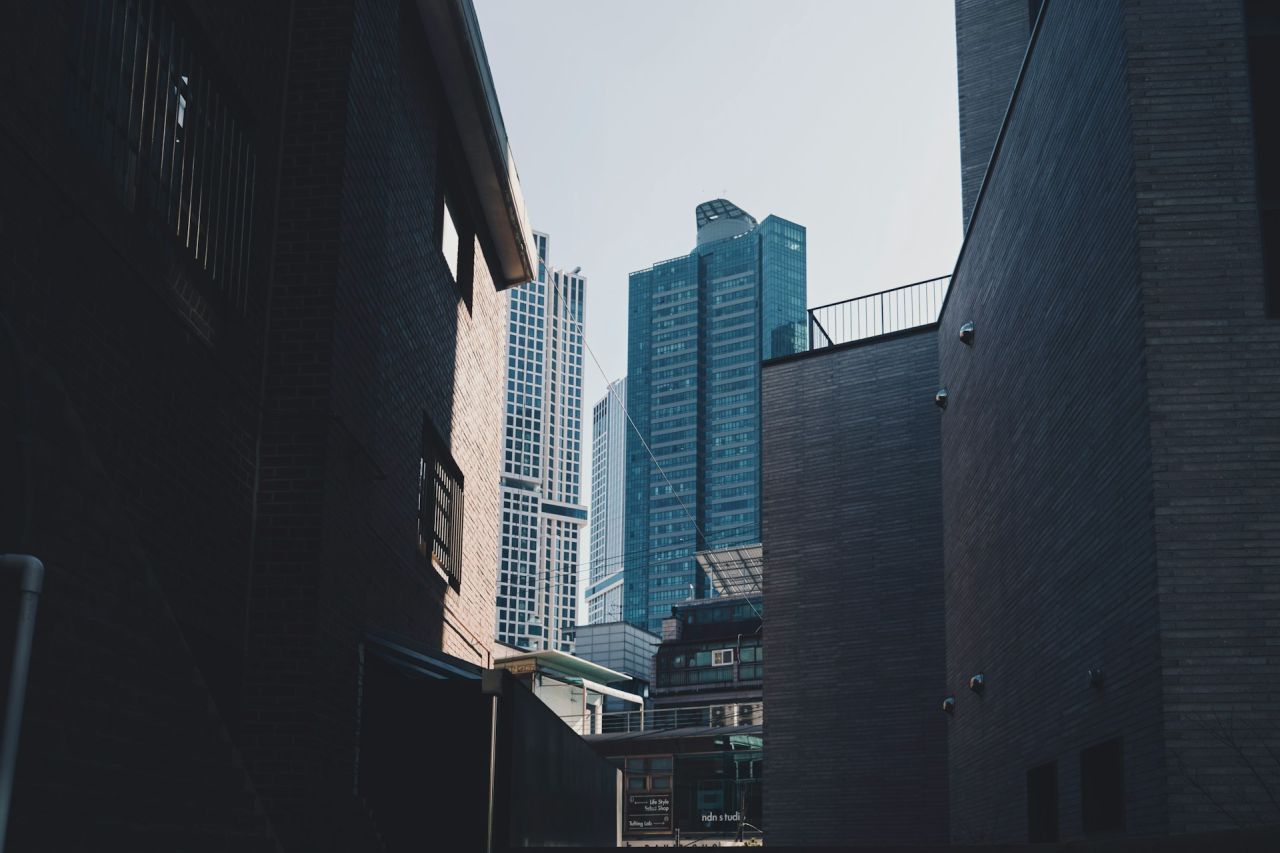
Outside the sky was a really nice blue, and the air was very clear so we could see the mountains clearly.
I wanted to walk around and take more pics but Julianne was freezing so we headed back to the apartment so that she could cocoon herself in a comforter while I played around on the Internet.
Julianne and I spent some time a couple days ago looking at online tutorials for how to use digital SLRs . . . I experimented with the TV setting on my camera trying to get better at setting the shutter speed . . . Julianne decided to pick up her camera before my camera had finished taking a picture of her camera . . . the ghost-effect is cool.
Julianne's camera has a very different interface menu so she had to spend some time figuring out what the Canon tutorial was saying for her Nikon . . .
The next day we went out for a walk. I was going to take a bizillion pics of the Kangwon University campus in Chuncheon but ended up just enjoying the walk . . . maybe I'll do a photo walking tour some other time of the campus.
Compared to Ehwa Women's Univesity, Yonsei University, and some of the other campuses I've seen in Korea there really wasn't all that much to take pictures of . . . that being said I didn't walk around the ENTIRE campus, just down the main road so maybe there are some picturesque sights . . .
We noticed this poster for its odd combination of Christmas with Halloween and pirates--I really don't know what the poster is for . . . maybe a costume party for the lunar new year in Asia?
We walked off the campus and just kept going, wandering around the area. I noticed these kimchi pots sitting on a balcony and thought it was kind of interesting how modern Korea finds ways to store its kimchi in order for it to ferment.
I'm working on a massive post right now about the whole 'qualified' vs 'unqualified' discourse that the Korean English online media seems to use frequently about foreign native English teachers . . .
The sheer volume of blog postings, 'news' articles, and editorials is unbelievable . . . but it's giving me something to kill time with while Julianne is teaching her winter English day camp to 15 middle school girls . . .
I'm confused . . . the article here talks about hiring Indians to teach in Seoul . . . and at the end of the article it drops this little gem,
"Meanwhile, the Seoul Metropolitan Office of Education announced yesterday that it will administer English essay-writing and teaching method exams to applicants when hiring English teachers, starting from next year." (my bold)
It seems like this is for native English teachers . . . lol.
If they use teaching method exams based on the Korean education system NOBODY from outside Korea will pass--NOBODY.
It would be nice to see some profile stories done by the Korean English media that showcase foreign English teachers in a positive light. The foreign teacher who IS qualified, and who does a good job. The foreign teacher who volunteers and contributes POSITIVE things to the local community and schools. These are things that we don't really see any kind of representation of in the Korean English media. The bizarre thing about this is that I know a couple of foreign teachers who are showcased frequently on Korean TV in a positive light . . . so I'm confused as to why there is such a difference between the TV media representation of foreign native English teachers and the online WRITTEN media representation of foreign teachers.
I have read on blogs written by expats that know Korean, however, that sometimes the TV showcasing of a foreign native English teacher is preceded or followed by a negative news story--for example, the mad cow fiasco. So any positive representations of foreign English teachers is contaminated by being juxtaposed with xenophobic sensationalized 'news' stories . . .
Anyways, here's a positive story that is unfortunately NOT put online by a Korean English news website . . . I'm going to look a bit online for some positive stories and see if I can find them--especially news stories that are not really about pushing the education policy and goals with the eye-candy representation of the foreign teacher as window dressing. I mean a REAL story that FOCUSES on a positive profiling of a foreign English teacher . . .
SEOUL — Early last year, GwanhoElementary School in Waegwon was on the verge of closing.
Enrollment at the 35-year-old school in the tiny village about 160 miles southeast of Seoul had dropped to 47 students, three shy of South Korea’s minimum requirement to keep it open.
"Everybody felt so embarrassed, depressed and shocked," principal Choi Jae-yeol said.
"Think about you having no school in your hometown."
The school’s community — teachers, parents, alumni and neighbors — began a campaign to save their school. And they came up with an idea: Ask the soldiers at nearby CampCarroll to help.
The soldiers agreed and began visiting the school regularly to provide English lessons. News spread, and more and more parents in the region looked to Gwanho as their preferred choice for their children.
Now, more than a year after the soldiers began volunteering, the school’s enrollment is up 64 percent and it is no longer on the government’s chopping block.
"The U.S. servicemembers saved our school," Choi said through an interpreter. "My heart is too full for words. What can I say but thank you, thank you."
The unit that started the volunteering left South Korea a few months ago, but the effort continues with soldiers from Service Company, 4th Battalion, 5th Area Defense Artillery, now stationed at Carroll.
"They begged us and pleaded with us, because the kids are really interested in having the soldiers read," 1st Sgt. Bernard Evans said of deciding to continue the volunteering, which is part of U.S. Forces Korea’s Good Neighbor Program.
I imagine that this kind of representation of Koreans would be part of the reason this story never hit the mainstream news outlets.
Now, every soldier in the unit is assigned to make a school visit, Evans said.
Each Monday and Tuesday, two soldiers and a KATUSA — South Korean soldiers assigned to U.S. military units throughout the peninsula — go to the school from 9 to 11 a.m. The South Korean soldiers go to help with interpretation for the adults.
WOW! The image of American soldiers as foreign native English teachers CO-TEACHING with KATUSA/Korean soldiers in the classroom is . . . wow. The thing is . . . I bet the co-teaching that goes on is SPECTACULAR. They might not be "co-teaching"--but what does that mean anyway? A lot of native teachers and Korean teachers do NOT have a shared definition of the term to begin with, so maybe this setup could be a model of what works well in Korea . . . I don't really think that, but it definitely broadens the range of what is possible and workable in terms of co-teaching, and what a native English teacher does together with a Korean English teacher in the classroom . . .
"The kids all speak English," Evans said.
The soldiers read with the kids and sometimes accompany them on field trips, he said.
Unfortunately this sounds like the soldiers become human CDs rather than doing any kind of teaching . ..
"We do whatever they have planned for that day," he said.
Evans said he tries not to send a soldier more than once, because the students can get so attached to individual personalities.
The idea of Korean children getting attached to American soldiers is something that I've never read about in the news here.Hmmmmmmmmm . ..
Lee Jeung-hee, an English-language teacher at the school, agreed that happens.
"The kids see them as their friends, a big brother or sister," she said.
That wasn’t always the case. The school serves a rice farming community, where, outside of the soldiers, few people of other races or nationalities visit. Seeing people of different skin colors and sizes, with scary-looking tattoos, intimidated some of the children at first.
"But the more I spent the time with them, the more I like them," said 12-year-old Kang Eun-jin, a sixth-grader. "I see them as my teachers as well as friends. They are very nice and friendly to us. It is really funny and interesting to be around with them."
Evans said trips to the school will continue as long as their mission allows.
Choi said now he’s facing a different problem.
Already, parents living in the next village have said they want to send an additional 15 students to the school. The increase may push some of the class sizes above 20 students and above the maximum requested by the military volunteers.
I'd like to see the kinds of reactions that would happen if the Korean government proposed using US soldiers stationed here on a much larger scale for learning and teaching English in the public schools . . . I imagine that it'd be tantamount to political suicide if a politician proposed the idea--but proposing using foreign native speakers of English who haven't graduated from university is a much better idea--nuh-uh.
"Now I am concerned and afraid whether more students would come and register to our school," he said.
There are about 15,000 North Korean defectors living in South Korea. That number is steadily growing. Most of them left the communist North to escape hunger, severe deprivation and political repression. Starting a new life in the advanced, capitalist South is daunting -- especially when it comes to getting an education. VOA Seoul Correspondent Kurt Achin traveled to a special school that is trying to level the playing field of opportunity for North Korean arrivals.
I think it's kind of interesting to consider that an individual has a lot of difficulties FUNCTIONING within an "advanced, capitalist" socio-cultural environment without a specific education and developmental environment. Makes you think about how much 'colonizing' of the mind goes on in education systems both in the West and the East . . .
Something else I just realized is that if there is only ONE school how does the Korean government help ADULTS assimilate back into the culture here? Where do they do this? I think I remembered reading something about a center that is used for this and how psychiatrists were just recently put in place there. The statistics for mental disorders went through the roof because there was someone actually in place that could assess the condition of the defectees . . . and this was RECENT news too. I guess if you defected earlier on in the center's history you were just out of luck . . .
The bell rings and uniformed students hurry to their next lesson. It looks like a typical South Korean school day. But, here, there are some big differences.
None of the students attending classes here were born in South Korea. All of them fled -- at one point or another -- from North Korea. They are among thousands of North Koreans who have arrived in South Korea after making an illegal border crossing into China, where they arranged passage here, often via travel brokers who operate in secret. The process is usually dangerous and traumatizing.
Because of the communist North's isolation and poverty, they have enjoyed few if any of the learning opportunities South Korean children take for granted. Because of food shortages, they are noticeably smaller than South Koreans. Even using their native language is hard, because the South's version of Korean has borrowed so many words from other countries, over the decades.
I've heard Korean English teachers complain about this linguistic phenomenon whenever I teach in-service training programs. It's something that doesn't seem to be talked about much because of the necessary bilingualism needed to make any kind of informed opinion.
This is also something that not many bloggers or editorials about reunification ever seem to address. If the North and South ever reunite how will they communicate? Apparently with great difficulty.
So here, at the Hankyoreh Middle and High School in the South Korean town, Anseong, they get special attention. The students eat, sleep and study on campus. Security is kept tight.
It's sad to think that when you escape North Korea you just end up in another kind of 'prison.'
It is South Korea's only publically-administered school exclusively for North Korean defectors. Principal Kwak Jong-moon says it is designed to meet every need -- not just academics.
So if the South Korean government actually is seeking reunification, and they have only built ONE school for rehabilitation/re-education . . . makes you think that something doesn't make sense . . . the public mission statement is that they want reunification, but the actual infrastructure that needs to be developed is almost non-existent.
He says the basic goal is to acclimate the North Koreans to the very different culture and society of South Korea. The school provides psychological counseling to help the students attain emotional stability. He says a range of medical treatment is also available.
It bothers me when I read about psychological/psychiatric methods being used in sync with 'education' to shape an individual's reality and psyche. I wonder if one of the North Koreans wanted to go back to North Korea if they'd be given the choice/liberty/right to do so . . . not that I'm saying I think any of them would choose to go back--but the right to do so should exist.
Most of the North Korean students have lost one or both parents or have left family members behind in the North. Kwak says the school does the best it can to fill that void.
He says teachers live with students, in the dormitories, and become a reassuring presence, just like mothers and fathers. He says they can sometimes even be better, because they can keep teaching the students after school, which many parents cannot do.
The students' curriculum includes everything from history to English to digital-media technology. They also play sports, from badminton to traditional Asian swordplay.
Students in a drama class have been rehearsing a play called "You Are Not Alone." Drama teacher Lee Do-ran says the young North Koreans appreciate the chance to act out the challenges of starting their new lives.
I would really love to see a translated version of the script for this play.
She says the culture shock North Korean defectors experience, when they first arrive in the South, can sometimes lead to conflict. She says the play deals with that and with other problems faced by all young people.
Interesting how role-playing helps to shape a person's 'reality stage' and the kind of 'role' that you play in REAL LIFE. Makes you re-think the kinds of role-plays and other uses of drama in an educational context. Add to the mix that it's not just a script with language that they lack and must learn, it's also all of the cultural norms that have to be learned, practiced, and naturalized.
Back in the dormitories, at night, the North Korean students say they spend much of their free time talking about life back home and their hopes of returning, one day. Twenty-one-year-old student Kim Kyung-ha says her life at Hankyoreh has helped her see the South differently.
I wonder if there are any North Koreans who have defected that are writing disapora stories of dislocation, identity, etc. It's something I might look into in the future.
She says, when she watched South Korean television in China, it looked as though everyone in the South was one big family. But she was disappointed to find that people here can be very cold. However, she says the teachers at this school are a big exception.
Wow . . . I wonder how South Koreans would respond to this observation? People would not be able to use the "You're not Korean" therefore "You don't understand Korea" logic in response to this criticism.
Kim and most of the other students are not expected to graduate formally from Hankyoreh. Instead, they will transition to regular South Korean schools when their teachers feel they are emotionally and academically ready for that challenge.
VOA News
The last thought I have about the article is that the isolation is not just for the 'benefit' of the North Koreans--I think there must be something in play here in regards to a kind of 'cultural quarantine' to prevent the North Koreans from 'infecting' South Koreans with the ideological programming of North Korean culture. I wonder what would happen if the defectees were allowed to have complete freedom when they enter South Korea. They would need to have some kind of support network for shelter, food, medical care, and education of course. But why not allow them to choose their own pace of re-entry into South Korean society? I'm sure there are a lot of other issues I'm not even touching on here, but the fundamental issue of liberty still remains.
J
I did a bit more surfing and came across this article with a lot more specific info . . .
"Up until the first 22 students came to the school when it opened in 2006, the government did not have any special curriculum for the defectors, who were usually so overwhelmed by schools in the South that they simply dropped out."
"Hangyoreh has been pushed to its limits due to an ever increasing number of defectors. About half of the 14,000 North Koreans who have defected to the South since 1989 have arrived in the last three years."
Not very encouraging when you consider what might happen if reunification ever does happen.
My name is Jason and I am a 34-year-old Canadian English instructor. I have been living and teaching in South Korea since March, 2005. This blog is about how I see life in Korea, and Korean culture. I will post pictures and video as often as possible. I will also write about Korean novels and movies.
Week in Review, 7/20 to 7/26
-
Welcome to another edition of SB Week in Review. Here’s all the news you
might have missed over the past week: Headlines TXT, BTS, Cortis, and Hwasa
won Da...
Readings, May/June 2026
-
May and June of 2026 were pretty good for reading! I we finished up some of
those translations projects I mentioned last month, and though more have
come i...
Eulogy for my Uncle Tony; Uncle Tony for President
-
[Part I: In which Rob uses humor to remember his Uncle Tony (plural)]
My Uncle Tony passed away in April.
For many readers of this blog, that doesn’t mea...
Rereading Discworld: Thud!
-
Thud! by Terry Pratchett (2005) 464 p. Discworld #34 (City Watch #8)
Ankh-Morpork is on edge. The anniversary of Koom Valley approaches: a
famous battle be...
BBB Ad Released!
-
The Bottomless Bottle of Beer!
JUST RELEASED!!!
NOW ON SALE!!!
On behalf of International Authors I am happy to announce the publication
of The Bot...
Reflections on my first Writing Retreat
-
This past weekend, I went on my first Writing Retreat to Davis, WV. It's a
bit tricky to leave all my responsibilities for a few days, but it seemed
like...
MENJAGA KESALAHAN PEMAIN
-
Salah satu hal terpenting untuk dipertimbangkan saat memainkan banyak game
online adalah jenis game yang Anda pilih untuk dimainkan. Cobalah untuk
menghi...
How Does a Bingo No Deposit Bonus Work?
-
Online bingo has become very famous in light of various factors, including
its accommodation, enormous game assortment, and rewards. Concerning last,
you c...
Squid Game (Ep: 9 Finale) | SeoulPodcast #193
-
We wrap up Squid Game season one and dish out trivia, wild theories, and
predictions for season two. Guest: Roboseyo Twitter:
https://twitter.com/robosey...
Useful Tricks Of Weight Loss Explained
-
Once you lose lots of weight, begin throwing out old, baggy clothes. This
activity a person with concrete proof your progress and enables you to be
more ...
– My Most Valuable Advice
-
Tips for Finding the Right Motorcycle donation You will need to get a
number of items. It is important that you get the right items by ensuring
that you ar...
What shoes to wear in the summer
-
Summer is the best time to experiment with fashion. Warm weather encourages
people to try wearing brighter and more cheerful colors as opposed to
winter wh...
Seoul, Uijeongbu Peace Statue, Budae Jjigae Street
-
*Statue of Peace, Peace Park*
After arriving at Uijeongbu station on Line 1, a full one and a half hours
from Gangseo-gu, I came out of the station (exits...
Three Days in Singapore
-
I have been living in Asia since 2008, and in that time I have travelled
around most of the countries in East, Southeast, and Southern Asia.
However, unt...
The End + 1
-
Well hey. So what's new?
I turned 50 recently. Here's a half-century update.
I gave up on China.
And I gave up on international schools, also.
I was ...
Ruby Rambles in Nepal
-
In 2007, I lived in Bhaktapur, Nepal just south of Kathmandu. I was
learning, teaching, almost getting married, and transforming myself yet
again. I wrote...
Hiking the John Muir Trail
-
*Note: This post is set up largely for my own planning. Expect updates, but
feel free to leave comments in the meantime. *
As a native-born Californian who...
The Fastest WordPress Theme
-
Lorem ipsum dolor sit amet, consectetur adipiscing elit. Nunc imperdiet
rhoncus arcu non aliquet. Sed tempor mauris a purus porttitor, ac convallis
arcu ve...
Essential Tips for a Korea Trip in August
-
Are you planning a trip in Korea during August and want to gather
information about things to do in South Korea? We have great news for you!
Korea has many...
The Best DJ Software: Programs To Consider
-
Producing Music Are you planning to make your own music? If you are, then
you should know about the music basics. There are many things that you
should kno...
Finally, Enchantments in Fall
-
It's been several years coming, but I finally made it to the Enchantments
during larch season. The Enchantments are a spectacular area in the Alpine
Lakes ...
Zandari Festa 2017 – Five Questions with PAKK
-
The sixth annual Zandari Festa is taking place in Hongdae from September
29 – October 1 with 120 international and domestic acts. To spotlight some
of the ...
Save pdf smaller size mac online
-
High image quality, bring your ideas to life save pdf smaller size mac
online beautiful presentations. and instantly got the shrunken file!
Although the de...
Liquidation vs. Penalty Damages in Korea
-
[image: Korea Liquidated Damages, Korea Penalty Damages, in Korea]
Liquidated Damages v. Penalty Damages in Korea
*Liquidated Damages vs. Penalty Damages in...
So, I'm in charge of
-
So, I'm in charge of lawn mowing now. And with that, the responsibility of
choosing a lawn mower that will be easy (for me, a lawn mowing novice)to
use. I ...
Broke my phone
-
Walking home from an off campus business presentation seminar I prepared
for the past few weeks, my phone slipped out of my hand, dropped two
stories, and ...
Happy Easter!
-
Yes, just like that bloke 2000 years ago, my blog has risen again on Easter
Sunday. Now that blogging is completely unfashionable, antiquated and of no
i...
Furniture By Mac & Wood: Reclaimed Wood & Steel
-
It is not often that I come across truly gorgeous and eye-catching
furniture pieces. But when I do, rest assured I will let you know as I will
do today. I ...
Foreign Teachers Returning to their Home Countries
-
*This Blog Has Moved*
Hey there everyone. In case you haven't updated your readers, this blog has
moved to a new, much better site. It's still Jackie, talk...
Lost in Translation
-
Three Things. 1. Loaded translations. Too much tipping the translations to
say what these videomakers want these women to say. And they sound like
they wer...
Is Blogging Dead?
-
This blog is not dead, it's just resting. (to coin a phrase from a certain
well known British comedy show).
I still maintain the Japan Blog List but the num...
Save Annie - help a sweet pit bull stay alive
-
I don't know why I didn't think of this sooner! Okay, I do, I almost never
write posts on this blog anymore.
The story: my boyfriend and I recently moved ...
The tastier side of Hamilton
-
I love food. Give me a dish from any culture and I will try it at least
once. It's very rare I find a dish that I dislike in its entirety. Given
the oppo...
Missing Foreigner Joy? Try American Joy
-
American Joy has been my new blog of my life back in America. Although I'm
busy being a grad student I try to keep up with it and give insights into
my...
Death by Optimism
-
I am so positive it's killing me. No, really. I believe that I will always
have more time, perform more perfectly, make changes more easily, and
basically ...
On Roboseyo’s Survey
-
Wow…it’s been a long time since I’ve posted. We are very welll and looking
forward to taking a trip back to North America for the summer break. As to
my la...
let it rain
-
i hate rain. rain is like the annoying little cousin of snow that wrecks
havoc and creates gloom and doom. unlike snow, who is soft and mature and
underst...
After giving it some thought.......
-
As you can see, it has been quite a while since I posted anything.
The longer I went without posting, the easier it became to go without
posting, if that m...
I'm Alive!
-
One thing I haven't been doing is writing. It's a pity. But I've been
thinking about it. Maybe it's like a muscle and I need to give it a
stretch. I was th...
New Blog…
-
I have permanently moved my efforts over to a new blog with a slightly
different aim. Still in the works, but follow if you wish!
http://redbelliedmustard...
Red Chapel Ironies
-
I recently got around to watching the Red Chapel, the unusual guerrilla
documentary by the Danish journalist Mads Brügger.1 The basic premise is a
visit t...
Valentine's Day Heart Collage Craft
-
Use fabric squares and other scraps to create this beautiul collage heart
craft for Valentine's Day. Follow the link for more details.
Fun at Chuirch
Mostly Harmless
-
When I was tentatively asked to move from working part-time to full-time at Busan
International Foreign School back in February – a job I finally began last...
Typhoon Bolaven
-
Kind of stressing about this typhoon. Supposed to be feeling the effects
from this evening until tomorrow evening.
This is from about 12 hours ago. It has...
Summer vaca
-
Steve's daughter Shelley got married this month. Steve and I traveled to
Pocatello, Idaho for her wedding. Afterwards we went camping around McCall,
Idaho....
Moving West
-
It's been so long since I wrote regularly here, I even had trouble signing
in an figuring out how to make a post! Sad! But I've been thinking about
coming ...
Please visit CrazyKoreanCooking.com
-
We are moving all our content to:
*crazykoreancooking.com*
Please visit and register to follow us.
Thank you for watching!
The Itch.
-
The Itch, The Bug... whatever you wanna call it, I got it. I've gotten a
taste and I def need more. Travel, that is.
So after re-reading my last post, whic...
Where Are You on the Korean Wage Scale?
-
The BBC has this interesting feature up on their website that shows the
average wage in many countries around the world. I was actually surprised
at how hi...
-
I made it back to Moran Market in Seongnam a few weeks ago (other parts,
1,2,). I had a student recently tell me that the market is slated to be
relocated ...
Goodbye WordPress
-
Update your links/bookmarks because I’ve moved. http://www.seoulfoodyo.com
Every single post I’ve made has been moved to the new site. I tried to
keep the...
Post #100: Goodbye Coco Busan, Hello Free Bird
-
Coco Busan started as a little idea in my mind 2.5 years ago in Edmonton,
Alberta, when I decided to leave Canada on my own and venture to Korea.
Once I pu...
This was this one time...
-
Oh China...blogging used to be so fun and easy. But now...not so much.
Thanks, Great Firewall! And also my own laziness! It also doesn't help much
that I'v...
Our year in pictures
-
I can't believe that it has been nine months since we left Korea and we
both still miss the people, food, and lifestyle. It really was one of the
best year...
Happy New Year!
-
It has definitely been a while since I last updated. Not a lot has
happened. Some good things and not so good things have happened since last
time. But ...
Farewell, Korea
-
Dear Korea,
We met two years + three months ago, and my what an adventure we've had!
You've changed a lot, and I have, too.
As I prepare to depart from y...
Old photos of Jeollanam-do and Gwangju.
-
[image: 1941 Jeollanamdo Provincial Office]
*Taken in front of the Jeollanam-do Provincial Office, 1941.*
[image: Sajik Park]
*Sajik Park observatory in the...
A Jeju-ful Weekend (2) - Sangumburi Crater
-
When you're a city bumpkin like me, being surrounded by nature and nature
only is something to relish. The fact that you can breathe in air that
smells of ...
I’ve Moved!
-
Hey folks: this post is so far overdue that it’s beyond ridiculous. I
started my new site almost EIGHT months ago, but never mentioned the change
here. Ter...
Back in the US of A
-
Actually, I’ve been back since May but I haven’t had the time to update my
blog. I’m glad it can still serve as a resource and source of entertainment
even...
campfires and memories
-
fire is a life force. it creates and destroys. a campfire creates not only
warmth but an atmosphere, a circle for campers to gather around to tell
stories....
One night in Bangkok
-
After Vietnam, we flew to Thailand, spent a day in bangkok and quickly
moved north to Chiang Mai where we participated in the Thai New Year, rode
elephan...
i HATE saying goodbye~~
-
those of you who know me already know how terrible i am at saying goodbye.
i loathe the concept so much that i usually just avoid the entire process.
sayin...
Grocery Shopping in Seoul
-
One of things I enjoy doing when visiting a foreign country is wandering
around a local grocery store. For one thing, you can find better deals on
local fa...
My Expert Knowledge on Eating in Nokdu next to SNU
-
Here’s all of my favorite places to eat in the Nokdu area next to SNU
(Seoul National University): http://goo.gl/maps/DYSy This took a little
longer than I...
Unemployment and Dominating the World
-
So we’ve been home since April 24th and needless to say I wasn’t prepared.
During the months leading up to our return to the US, friends and family
keep as...
Feeling the Love
-
I wrote some "Stories of Absurdity" a few posts ago and recently noticed
wow, people are actually reading what I write. It makes me feel all warm
and fuzzy...
Know Your Spirits: Sambul Jeseok (三佛帝釋)
-
Whether it's from red neon crosses lighting up the night sky or the sound
of monks rapping on *moktok* it is not unusual to encounter evidence of the
inf...
I'm Her Little Man
-
I've always been more of a "toast and jam" kind of girl, but over winter
break in California I discovered the pleasures of bread and butter. For
Christmas,...
Christmas in Thailand!
-
I know I haven't posted in forever, but I have to write about Thailand!
We left Friday after work for the airport. It was so cold, I couldn't feel
my toes. ...
Welcome to Expacked (Issue #100)
-
Welcome to the final issue of Expacked. When we first started talking
about making a newsletter for native English teachers in Korea, we never
dreamt that...
Merry Christmas
-
At first glance, your average KM heading out to freshen up her perm, or
making a Costco run for that last minute economy pack of socks, or giving
stank eye...
The South Korea Survival Guide
-
"Sara, do you have indoor plumbing in South Korea?” “Isn’t it really hot
out there all the time?” It’s amazing what some people still don’t seem to
unders...
Open Class
-
This past week was insanely busy. We had Open Class, video taping,
International Food Day, birthday parties, New Teacher training, and several
more smaller...
Farewell Korea!
-
Our year in Korea as a foreign teacher is now over. Korea has been really
good to us. It was the first time for both of us to be away from home for
more th...
Driving in Korea
-
I never gave much credence to the stereotype that Asians are bad drivers,
but after 2 years in Korea I've changed my mind. Koreans are the WORST
drivers. T...
Cooking class
-
We used 3 weeks to learn cooking Korean food
- Bibim noodle
- Cucumber kimchi
- Kimbab
- Nalchi-ar-bibimbap
Most of the time we had too many students and...
See what I see #2
-
Every day I climb on the back of a little guy’s motorbike and he drives me
to school, for the princely sum of $1. Here are some shots from my journey
on F...
Dr.Fish and Korea Fighting!
-
Since first hearing of the "Dr.Fish" phenomenon a few years ago, the idea
has been locked in the ever-present,
weirdly-grotesque-but-insanely-interesting ...
The Music Industry Is Indeed Doomed
-
As Thom Yorke said in a recent interview for a British civics textbook (how
great would that textbook be, by the way? I don’t remember reading any
intervi...
The Sunset Post
-
Jumping the Asymptote has been running almost 17 months now. I no longer
live in Korea. I spent about six months after that in China, and have since
then f...
a breath of fresh air
-
A breif thundershower this afternoon helped clear up the air a little. I
like the freshness of the air in Seoul after it rains. I try to breathe as
much i...
The Master
-
During a break from pinning dyed fabric in 2001, I snapped this moseup of
the Master against an Autumn sky. You can tell from his face that he loves
me rig...
Phili-Phili-Philippines!!!
-
Alright so I am well aware that I havent posted anything on here in
months…. I blame it on winter hibernation… Since I thawed out in the
Philippines and it...
Sea Mustard ChoMuChim
-
This is a simple and cool Korean seaweed side dish. When my husband and I
visited Korea last February, he had the chance to try this side dish in a
restaur...
 The next day (today) I headed downtown to run some errands. It was nice outside although a bit cold.
  I LOVE how delivery trucks in Korea pretty much operate however they see fit. I would absolutely be in photography heaven if this truck got in an accident (and nobody was hurt, of course) and the eggs went flying EVERYWHERE--lol.
  Inside McDonalds waiting for our food I tried to do a 'cool' pic . . . TRIED . . . nope. I was hoping to get the image of the room reflected on the surface of the Christmas ball . . . argh.
 Outside the sky was a really nice blue, and the air was very clear so we could see the mountains clearly.
 I wanted to walk around and take more pics but Julianne was freezing so we headed back to the apartment so that she could cocoon herself in a comforter while I played around on the Internet.




.jpg)


